As construction projects continue to become larger and more complex, reinforcement connection methods must provide not only structural reliability but also higher installation efficiency. Traditional approaches such as lap splicing and welding have supported construction for decades, but they often require more labor, longer installation time, and additional site preparation. A one touch coupler offers a modern alternative by simplifying the connection process and improving productivity in reinforcement assembly. Unlike conventional connection methods that depend heavily on overlapping steel bars or complicated installation procedures, this advanced mechanical connection solution allows workers to complete rebar joining more quickly while maintaining stable connection performance. For high-rise buildings, infrastructure projects, and prefabricated structures, selecting the right connection method can have a direct impact on construction speed, cost control, and overall project quality.
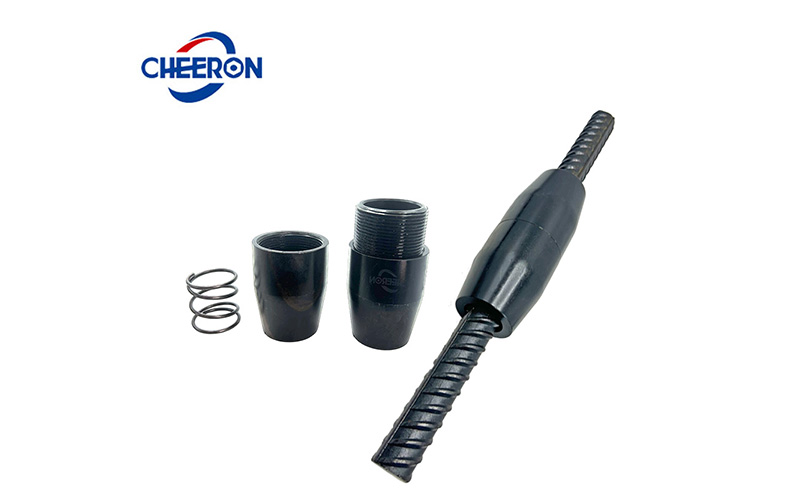
A one touch coupler is designed to provide a faster and more convenient way to connect reinforcement bars compared with traditional rebar splicing methods. The main difference lies in its installation approach. Instead of requiring extensive preparation, a one touch rebar coupler allows steel bars to be connected through a simplified mechanical locking process, reducing the number of steps required on the construction site.
Compared with Overlapping Joints
Traditional lap splice methods rely on overlapping sections of reinforcement bars to transfer loads. While widely used, this approach consumes additional steel material and requires more space inside reinforced concrete structures. As reinforcement density increases, overlapping bars can create congestion and make concrete placement more difficult.
Compared with Welding
Welding connections provide another traditional solution, but they require skilled workers, welding equipment, and suitable working conditions. Factors such as weather, site safety requirements, and quality inspection can influence welding efficiency.
Compared with Threaded Mechanical Connections
Compared with these methods, traditional threaded couplers already improve connection reliability, but they usually require precise alignment and additional installation procedures. A one touch coupler focuses on simplifying the connection process, making it especially valuable for projects where installation speed and operational convenience are important.
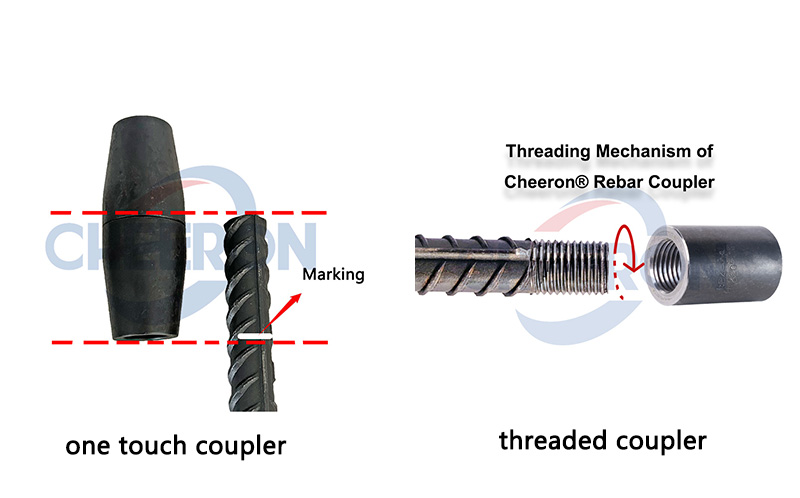
Both one touch connection systems and threaded mechanical splices are widely used for reinforcing steel connections. However, they differ in installation methods, equipment requirements, and application flexibility.
| Item | One Touch Coupler | Threaded Coupler |
|---|---|---|
| Installation speed | Faster connection process with fewer installation steps | Requires alignment and threaded engagement |
| Required tools | Usually requires fewer installation tools | May require threading equipment and inspection tools |
| Working conditions | Suitable for projects with limited space and demanding schedules | Suitable for projects requiring conventional threaded connections |
| Labor demand | Lower labor involvement due to simplified operation | Requires more preparation and installation procedures |
The choice between a one touch coupler and a threaded system depends on project requirements. Threaded couplers remain a reliable option for many construction applications, while one touch solutions provide additional advantages when installation speed and convenience are major priorities.
For projects requiring rapid reinforcement assembly, such as large commercial buildings or infrastructure developments, the simplified design of a one touch rebar coupler can provide meaningful efficiency improvements.
Modern construction projects increasingly focus on improving productivity without compromising structural performance. A one touch coupler rebar solution provides several practical advantages for contractors and reinforcement specialists.
The key benefits include:
Faster installation: The simplified connection process reduces the time required for joining reinforcement bars, helping construction teams complete structural assembly more efficiently.
Lower labor requirements: Because the installation procedure is easier to perform, fewer workers and less manual effort may be required compared with traditional connection techniques.
Reliable mechanical performance: A properly installed coupler provides consistent load transfer between reinforcement bars, supporting structural stability.
Better performance in limited spaces: The compact connection design is suitable for areas where reinforcement congestion makes lap splicing difficult.
For projects with tight schedules, the use of a one touch coupler can help improve workflow efficiency. Workers can spend less time on complicated connection procedures and focus more on overall construction progress.
Beyond installation speed, a one touch coupler also contributes to better construction management. Large-scale projects often involve thousands or even millions of reinforcement connections, meaning small improvements in each connection can create significant time savings throughout the entire project.
By reducing installation steps, the system helps minimize variations caused by different operators. A standardized connection process improves consistency and reduces the possibility of human errors that may occur during manual operations.
Safety is another important consideration. Compared with welding-based connections, mechanical connection systems reduce the need for hot work activities at construction sites. This can help simplify safety management, especially in underground structures, tunnels, and high-density construction environments.
For contractors managing complex projects, choosing a suitable one touch coupler means gaining better control over installation quality while maintaining construction efficiency.
Selecting the appropriate coupler one touch solution requires consideration of several technical factors. Different construction environments may require different connection specifications, so project engineers should evaluate the following aspects before choosing a product.
The first consideration is rebar diameter. The selected coupler must match the reinforcement size used in the project to ensure proper connection performance. Construction teams should also confirm the strength grade of the steel bars because different structural requirements may require different mechanical connection capacities.
Application conditions are equally important. Projects involving high-rise structures, bridges, tunnels, or seismic areas may have specific requirements related to load performance, durability, and installation conditions.
A reliable one touch coupler supplier should also provide technical information and product specifications to help customers select suitable connection solutions. Companies specializing in reinforcement connection technology can offer different types of couplers designed for various construction environments.
A one touch coupler is used to connect reinforcement bars in concrete structures through a simplified mechanical joining method. It replaces or reduces the need for traditional lap splicing and welding methods while providing a reliable structural connection.
Yes, a properly designed one touch rebar coupler can be used with high-strength reinforcement bars when the product specifications match the required steel grade and project standards.
Installation speed depends on the specific product design, worker experience, and project conditions. However, a one touch rebar coupler is generally designed to reduce connection time compared with traditional methods by simplifying the installation process.
The main difference is the installation method. Threaded couplers require prepared threads and precise engagement, while a one touch coupler focuses on faster connection through a simplified mechanical locking structure. The best choice depends on project requirements, construction conditions, and installation priorities.