Prefabricated buildings are becoming increasingly common in our lives. The typical modular construction method allows the buildings to be arranged in an orderly manner, like building blocks, with refined management. But precast concrete can make construction fast, clean, and safe—only when the connections are designed correctly.

A precast beam, column, wall panel, or other component is made with impressive dimensional accuracy, yet the structural system ultimately depends on what happens where those elements meet. That is why reinforcement connection schemes become critical. Among the available solutions, mechanical splices of bars, including common mechanical rebar couplers and grouted sleeves, have become important ways for creating reliable reinforcement continuity.
But choosing a coupler does not simply match the rebar diameter. The connection scheme must consider load paths, concrete behavior, installation tolerances, reinforcement congestion, testing, and applicable design requirements. This guide explains the major reinforcement splicing couplers used with precast elements and shows how reinforcement couplers fit into the bigger structural picture.
In conventional cast-in-place construction, reinforcement can often be installed continuously before concrete is poured. Precast concrete is different. Components are produced separately, transported, lifted, positioned, and connected on site. The reinforcement therefore has to cross a physical interface between independently manufactured components. Think of the joint as a bridge between two structural bodies. If that bridge cannot transfer the required force, the strength of the individual components does not solve the problem. A connection must therefore maintain the intended structural behavior of the overall system.

Precast making provides excellent opportunities for controlled production, but it also creates geometric constraints. Reinforcing bars may need to emerge at precise locations. During erection, those bars must align with sleeves, couplers, pockets, or other connection devices.
A connection zone is usually more complicated than an ordinary section of reinforcement. Several mechanisms may interact: reinforcement tension, compression, shear transfer, concrete confinement, anchorage, bearing, and local cracking. The designer and contractor therefore needs to understand the complete load path.
A reinforcement coupler is used to connect reinforcement between precast components and ensure that the intended structural forces can cross the rebar splices. The mechanical coupler is a physical device—such as a threaded coupler or grouted sleeve.
This article scheme uses mechanical couplers: threaded couplers, grouted sleeves, welded reinforcement coupler, post-tension threadbar coupler or combinations of these methods.
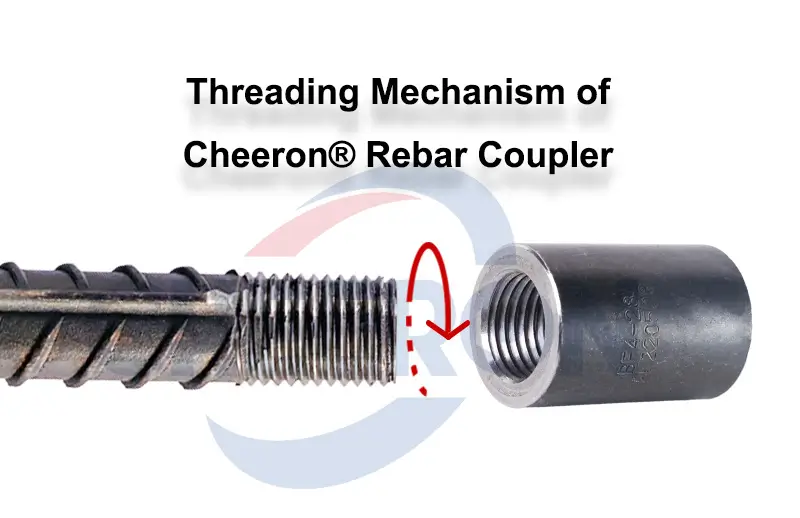
A reinforcement connector works by creating a reliable load path between reinforcement bars. With a mechanical threaded coupler, forces are transferred through the connector and its engagement with the reinforcing bars.
With a grouted sleeve, forces are transferred through the interaction of the reinforcement, grout, sleeve, and surrounding structural system.This is why connector design involves much more than choosing a sufficiently thick piece of steel. Geometry, material properties, thread engagement, confinement, anchorage, and deformation behavior all contribute to performance.
Depending on its location, a reinforcement connection may need to transfer tension, compression, bending-related forces, shear, or combinations of these actions. The required performance depends on the structural system and design assumptions.
For a tension connection, reinforcement continuity and tensile strength may dominate.
For seismic applications, additional demands such as cyclic behavior, ductility, and deformation capacity may become critical.
So, what is the strongest coupler? There is no universal answer. The better question is: which mechanical splicing couplers for reinforcement can reliably deliver the required structural performance in this specific application?
Several reinforcement connection methods are used in precast construction. Each has advantages and limitations, and the appropriate solution depends on project requirements
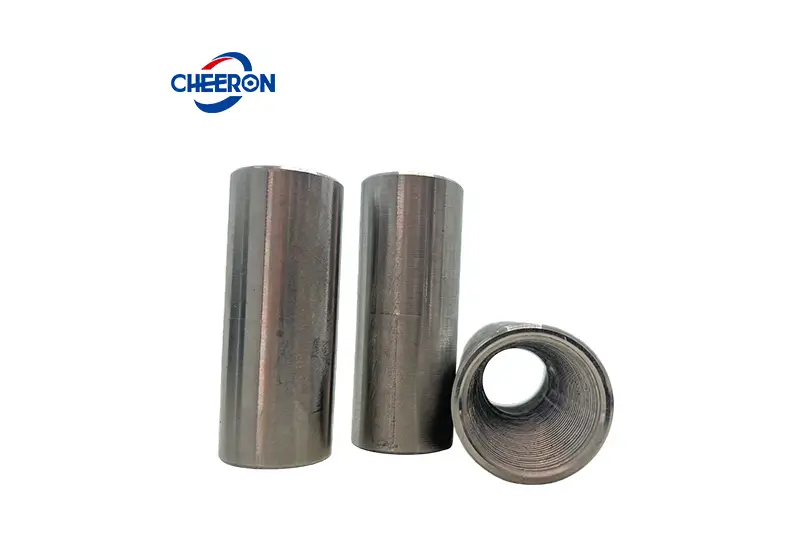
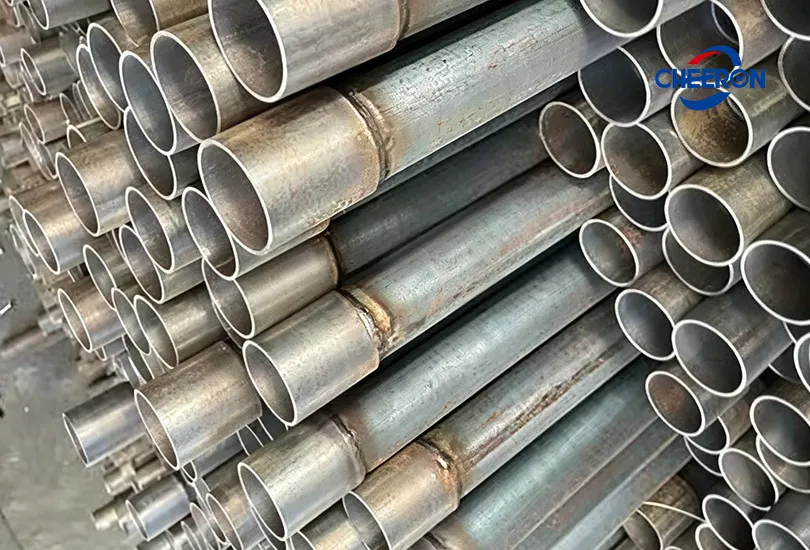
Grouted sleeves provide a widely used method for connecting reinforcement between precast concrete. The reinforcing bars of the component are inserted into the grout sleeve, and then the reinforcing bars of the corresponding precast elements to be connected are placed in place. Finally, high-performance cement grout is injected to complete the load transfer.
It meets certain installation requirements.The grouting sleeve itself can absorb assembly errors in the component connection. For example, Cheeron grouting sleeves have internal limiters to control the insertion depth of the reinforcing bars.
It ensures the continuity of the reinforcing bars without the need for traditional overlap lengths.
Unlike traditional mechanical splicing of reinforcing bars, grouting sleeves utilize the gripping force created by the hardening of the chemical grout to achieve force transfer. Extensive experimental research has confirmed its superior safety performance.

Correct bar insertion, grout quality, filling, venting, curing, and inspection all affect performance.A sleeve that looks perfectly installed from the outside may still contain an internal defect. That is why installation procedures and quality control cannot be treated as paperwork afterthoughts.
Mechanical threaded couplers connect reinforcing bars through manufactured threads. Depending on the system, the rebar may be threaded directly or prepared through processes such as thread rolling after suitable bar-end preparation.(Click to learn the difference between thread rolling and threading directly for rebar)
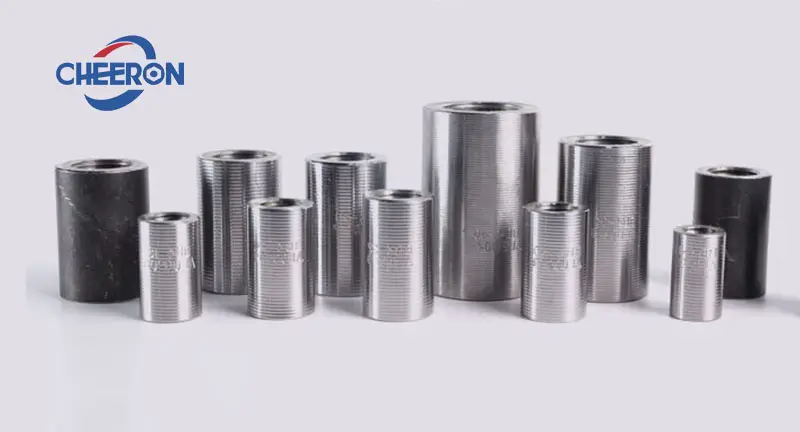
1.Threaded couplers provide safe connection in congested spaces
Reinforcing bars must transfer forces safely across joints, often within surprisingly small and congested spaces in precast components.
Threaded couplers can provide a compact connection and can be particularly useful where reinforcement congestion makes conventional lap splicing difficult. They also allow reinforcement continuity without requiring welding at the connection point.
2. A variety of threaded couplers are available
Threaded mechanical rebar connectors are among the most versatile rebar connectors. New solutions can be developed for every specific construction characteristic.
Split-type Position couplers
For example: In precast components, where rebar cannot rotate, the Cheeron split-type rebar connector, a fixed rebar coupler, can connect rebar without rotating it.

Male-female adapter threaded couplers
In precast components, where rebar has errors, special male-female adapter threaded joints can fill the gaps between rebars, reducing installation errors.

Threaded rebar couplers can use different thread geometries. Parallel-thread systems generally maintain a constant thread diameter, while taper-thread systems use a changing thread geometry designed to achieve the intended mechanical engagement.(What is the difference between straight threads and tapered threads?)
The important point is not which thread looks more sophisticated. The important question is whether the complete system has been engineered and tested for the intended reinforcement grade, diameter range, load requirements, and installation procedure.For manufacturers and buyers, thread terminology should therefore be accompanied by actual technical specifications and qualification evidence.
The thread must be compatible with the coupler, and installation must achieve the specified engagement. Thread quality, bar-end preparation, coupler dimensions, cleanliness, and inspection all matter. A threaded connection is a mechanical system—not simply a coupler screwed onto a bar.(Learn more Questions for Rebar Connector Installation)
Mechanical rebar anchoring is a common practice in precast concrete to address insufficient straight anchor length. It is often used for anchoring at both ends.

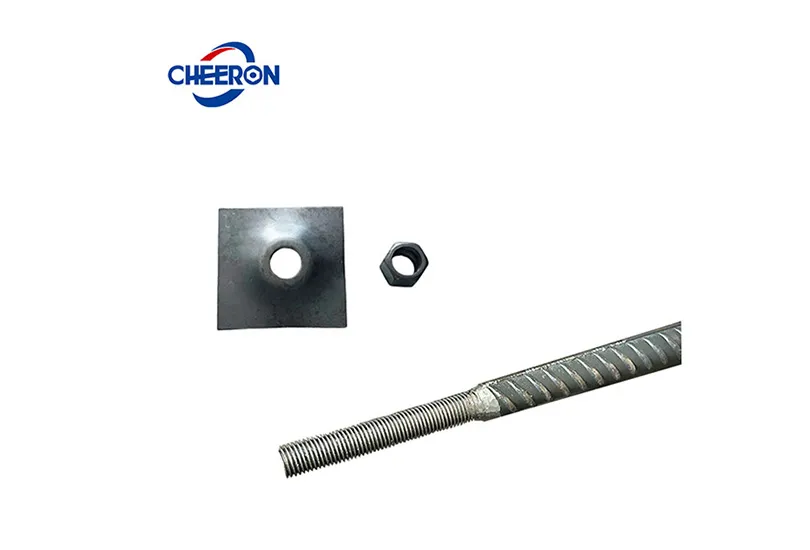
Weldable couplers are welded to a steel plate on one side and threaded to a rebar on the other.

In prefabricated bridge construction, prestressed rebar are mostly used for connections between components and segments. Using tension threadbar couplers for connection and anchoring effectively transmits force.

Mechanical couplers and grouted sleeves can both provide effective reinforcement continuity, but they solve the installation problem differently.
Mechanical couplers generally provide a direct mechanical connection, while grouted sleeves rely on the combined behavior of reinforcement, grout, and sleeve.
Mechanical couplers may be attractive where compactness, direct engagement, and rapid installation are priorities.
Grouted sleeves can be useful where precast detailing and erection methods are designed around sleeve connections.
The comparison should therefore consider installation speed, tolerance, available space, equipment, inspection, project standards, cost, and structural performance, rather than simply asking which technology is “better.”
Mechanical Threaded Couplers | Grouted Sleeves | ||||
Couplers Type for Prefab | Threaded Rebar Couplers | Mechanical Anchoring | Weldable Couplers | Tension Threadbar Couplers | Grouted Sleeves |
Connection Method | Full Threaded Connection | Full grouting/semi-grouting semi-threading connection | |||
| Strength | High | High | |||
| Features | No waiting required; installation can be completed quickly by a single person; threaded connections require higher installation precision | Maintenance is required after grouting, and grouting requires two people to work together, making it slower; allowing for a certain degree of error, reducing the precision required for reinforcing bar installation. | |||
Application in Prefab | Precast Concrete | Composite Components | Precast Steel-Concrete | Prefabricated Bridge | Precast Components |
Coupler selection should begin with the structural requirement, not the catalog. A useful selection process starts by identifying the reinforcement size and grade, required connection performance, joint configuration, installation method, environmental exposure, and applicable standards.Once those requirements are established, manufacturers can be compared on a technically meaningful basis.
The connector must be designed and qualified for the specific reinforcing bar size and grade being used. Metric and imperial reinforcement systems also require careful attention because nominal bar sizes do not always translate directly between systems.Do not assume that a connector labeled for a particular bar diameter is automatically suitable for every steel grade. The complete combination of bar size + steel grade + connector + installation method should be verified.

Where will the connection be located? Inside a wall panel? Between precast columns? At a beam-column interface? Within a foundation element?The answer affects connector selection. Some systems require relatively precise alignment, while others provide greater tolerance for construction variation. In precast projects, this distinction can make the difference between a smooth installation and a site problem that stops the entire erection sequence.
A connector intended for ordinary tension continuity should not automatically be treated as suitable for every structural application. Projects involving high seismic demand, fatigue, cyclic loading, or critical structural zones may impose additional performance requirements. Engineers should identify the applicable design category and qualification requirements before specifying the connector.
Durability also matters. Connections exposed to moisture, chlorides, chemicals, freeze-thaw conditions, or other aggressive environments may require additional protection or specific material and detailing strategies.The connector is buried inside the structure, but that does not mean durability can be ignored. A connection designed for strength but neglected for long-term exposure is only solving half the problem.
Even a good connection system can fail as a project solution if installation is poorly controlled. Several problems appear repeatedly in practice.
Misaligned reinforcement can prevent proper engagement with a coupler or sleeve. For precast manufacturers, this means reinforcement positioning during fabrication deserves the same attention as concrete dimensions.
With threaded couplers, insufficient engagement can reduce the effective load-transfer area. Workers may also encounter difficulty when debris, damaged threads, incorrect bar preparation, or alignment problems interfere with assembly.Clear installation marks and inspection procedures can help verify that the required engagement has been achieved.
Grouted sleeve systems introduce a different risk: incomplete filling. Voids, poor grout mixing, improper placement, leakage, or inadequate curing can compromise the intended load-transfer mechanism.Grouting therefore needs controlled procedures rather than a simple instruction to “fill the sleeve.” Material preparation, equipment, temperature, injection method, and inspection all matter.
Perhaps the biggest procurement mistake is choosing a connector based only on price, appearance, or nominal size. Structural connectors should be supported by appropriate technical documentation and qualification evidence for the intended application. A cheaper connector is not necessarily cheaper if it creates installation delays, failed inspections, rework, or uncertainty about structural performance.
Standards and project specifications provide the framework for determining whether a reinforcement connection is acceptable. Requirements vary by country, structural code, reinforcement type, and application, so the applicable standard must be identified for the specific project. Common qualification concepts include tensile performance, deformation or slip behavior, dimensional inspection, material verification.
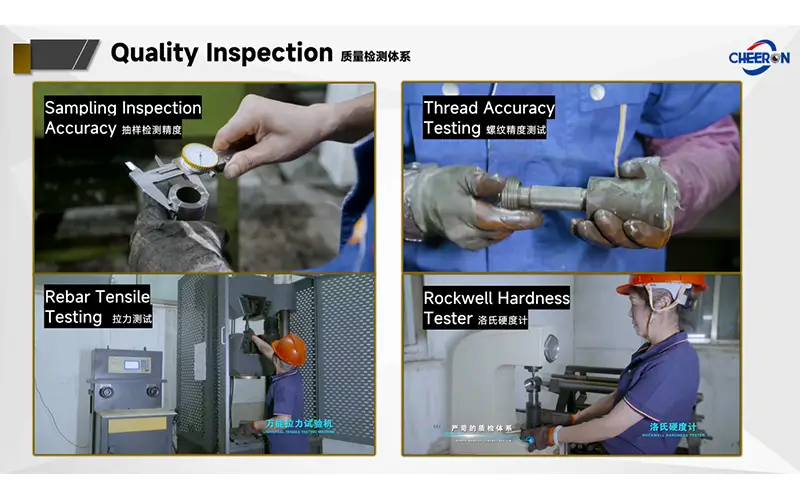
— Dimensional and Thread Inspection
— Tensile Testing
— Slip and Deformation Requirements
More: what tests are required for qualified rebar couplers?
Reinforcement connection schemes are one of the most important pieces of the precast construction puzzle. Whether the project uses threaded rebar couplers, grouted sleeves, weldable couplers, threadbar couplers or another system, the real objective remains the same: create a dependable load path between precast components while making installation practical and repeatable.
The best connector is not necessarily the largest, strongest, or cheapest one. It is the connector that fits the structural requirements, reinforcement, concrete detailing, installation tolerances, applicable standards, production process, and project budget. For engineers and precast manufacturers, the key lesson is simple: do not design the component first and worry about the connection later. Design the connection as part of the component from the beginning. When the connection is treated as an integrated structural system rather than a small piece of hardware, precast construction becomes faster, safer, and much more predictable.